Line Overview: What a 500 kg/h Setup Delivers
A 500 kg/h sawdust charcoal briquette production line is a mid-scale industrial setup designed to convert loose sawdust into dense, uniform briquettes suitable for heating fuel or further carbonization (depending on the product you plan to sell). At this capacity, the line must run continuously with stable feeding, consistent moisture control, and enough drying and cooling time to avoid cracking or soft briquettes. In practice, “500 kg/h” usually refers to finished briquettes under defined moisture and density targets, so the real output depends on raw material moisture, dryer performance, and press stability.
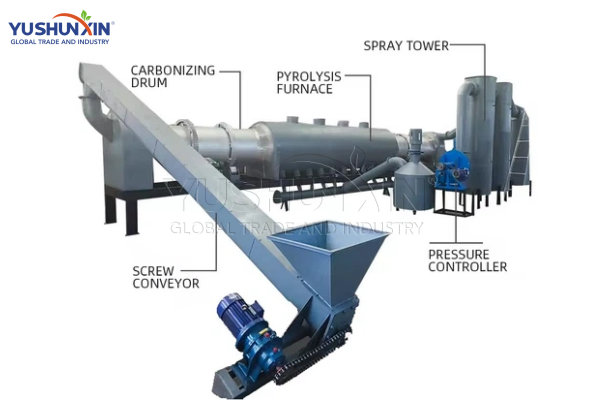
Process Flow: From Sawdust to Finished Briquettes
The standard process begins with sawdust screening to remove stones, metal, and oversized chips. Next comes drying, because most briquette presses require sawdust moisture in a narrow band (often around 8–12%). A rotary dryer or belt dryer is commonly used, paired with a heat source such as a biomass burner, gas burner, or furnace. After drying, material moves through buffer silos and screw conveyors to maintain steady feeding. The core forming step is the briquetting machine (often a screw extruder for biomass briquettes), producing solid or hollow “logs.” After pressing, briquettes are cooled, sometimes cut to length, and then packaged for storage and shipment.
Full Equipment List (Typical Configuration)
A practical 500 kg/h line often includes: raw material hopper; vibrating screen; hammer mill (if particle size needs reduction); rotary/belt dryer; hot air furnace or biomass burner; cyclone + bag dust collector; screw conveyors; storage bin/silo; 500 kg/h briquette press; cutting unit; cooling conveyor or cooling racks; control cabinet (inverter/PLC depending on automation); and basic packing equipment (weighing scale, bagging/sealing). If you’re selling charcoal briquettes (not raw biomass briquettes), add a continuous carbonization kiln/furnace, cooling system, and possibly a secondary crusher and mixer if you plan to bind and re-press charcoal fines.
Price Breakdown: Where the Budget Goes
The biggest cost drivers are typically the drying system and heat source, followed by the briquette press, then conveyors and dust collection. In many projects, the dryer package (dryer body, burner/furnace, fans, ducting, cyclone, controls) is the single largest portion because it determines energy use and product quality. Automation level also shifts pricing: manual feeding and simple controls reduce upfront cost but increase labor and downtime, while PLC control, metered feeding, and automated packing add capital expense but stabilize output.
Operating Costs and Payback Considerations
Beyond purchase price, plan for electricity (motors, fans), fuel for the furnace, binder cost (if used), wear parts (screw, die, bearings), and labor for handling and packing. Profitability depends on local sawdust price, drying fuel availability, and target market pricing. Before committing, request a supplier’s layout drawing, energy consumption estimates, guaranteed capacity conditions (moisture/particle size), and a clear list of included accessories—those details are what turn a “500 kg/h line” into a reliable, bankable production system. Visiting: https://www.char-molder.com/product/sawdust-briquette-charcoal-making-machine/
Leave a Reply