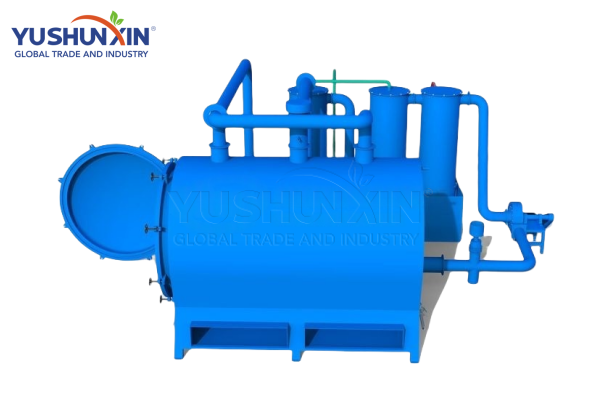
Agricultural residue, sawdust, palm shell, rice husk and wood waste often travel to landfill or open burning sites because no local processor accepts those volumes, and you, as a recycling company or as a biomass project developer, can convert that material into charcoal, biochar and useful heat. The syngas utilization technology for carbonization plants captures the combustible gas that the furnace releases and returns it to the process as fuel. That internal energy loop turns a waste stream into a resource, and the syngas utilization system technical route defines how much energy your plant recovers per tonne.
Which stages define a syngas utilization system technical route?
The route begins with drying, because moisture in the feedstock consumes heat and lowers the calorific value of the gas. Carbonization follows inside a sealed reactor, and that reactor produces char, tar vapour and combustible gas in one continuous pass. A cyclone, a scrubber and a tar separator clean the gas before it enters the burner, and that cleaning protects the burner nozzle from deposits. Your process engineer then routes part of the gas to the reactor and the remaining gas to a boiler, a dryer or a generator set that supplies the site load.
Which carbonization equipment captures syngas safely?
A continuous carbonization furnace with sealed discharge, pressure control and flame arrestors protects the operators and the building, and that protection remains essential in every operating condition. A carbonization syngas recovery system includes a gas holder or a buffer line that absorbs fluctuations, and that buffer keeps the burner stable when the feed rate changes. Treatment equipment with temperature sensors at three points gives your control room a reliable picture of the reaction zone. The gas cleaning section and the tar collection tank complete the system and reduce the maintenance hours that your team spends each month, while a charcoal briquette forming line densifies the fine char into a transportable product with a higher sale value.
How do you convert syngas into heat and power for a biomass project?
The recovered gas drives a thermal oil heater, a steam boiler or an internal combustion generator, and the choice depends on the local demand for heat and electricity. A plant that dries its own feedstock uses the gas internally and reduces its external fuel purchase to almost zero. A plant that sells electricity to the grid needs a generator set with gas conditioning, and that configuration requires a higher investment with a longer operating horizon. Your energy balance calculation shows which configuration fits the load profile of your project, and that calculation guides the final equipment list.
How does a carbonization project measure landfill diversion?
Your operations team weighs every incoming tonne of biomass and every outgoing tonne of charcoal or biochar, and that record produces the diversion figure that your client reports. A syngas utilization system technical route with a documented mass balance also supports carbon removal accounting, because the solid carbon that stays in the char represents a long-lived storage medium. The monitoring plan includes gas flow, temperature and residence time, and those parameters demonstrate that the plant operates inside its design envelope. That documentation also strengthens the case for municipal contracts and for carbon credit registration.
Conclusion for project developers and recycling companies
Landfill dependence drops when a project processes local biomass and uses its own gas instead of purchasing external fuel for drying and heating. A biochar machinery supplier that supplies the furnace, the gas train, the briquette section and the control logic as one coordinated package reduces interface risk for your engineering team. The syngas that the furnace releases carries meaningful chemical energy, and that energy pays part of the operating cost of the plant. If your development team needs a reference for capacity and layout, you can learn more about https://www.char-molder.com/product/continuous-carbonization-furnace/ before the next site visit.