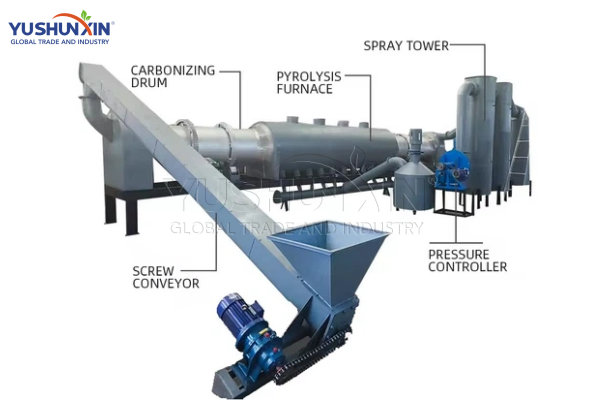
A continuous carbonization machine is designed to convert biomass into charcoal in a steady, uninterrupted process rather than in batches. For industrial charcoal production, this matters because stable feeding and continuous discharge can deliver higher throughput, more consistent quality, and better labor efficiency. The “right model” is the one that matches your raw material, production target, and emissions requirements while keeping operating costs predictable. Before comparing specifications, define what you are producing—fuel charcoal, BBQ charcoal, shisha/hookah charcoal, or charcoal fines for briquettes—because the desired fixed carbon, ash level, and strength will influence the machine type and process settings.
Match the Model to Your Feedstock and Preparation Line
Feedstock is the first filter when choosing a continuous carbonization machine. Hardwood chips, sawdust briquettes, coconut shells, rice husk, palm kernel shells, and bamboo behave very differently during heating. Some materials produce more volatiles and require stronger gas handling; others generate high ash that affects final charcoal grade. Check the required particle size range, allowable moisture content, and whether you need pre-drying. Many continuous systems perform best when moisture is controlled (often below 15%, depending on design). If your supply varies by season, prioritize models that tolerate variation without frequent shutdowns or charcoal quality swings.So, you can choose a suitable machine according to your biochar production equipment.
Key Equipment Types: Rotary Kiln vs. Continuous Retort vs. Screw Reactor
Common industrial choices include rotary kilns, continuous retort carbonizers, and screw-type carbonization reactors. Rotary kilns handle mixed sizes and can be forgiving, which suits operations sourcing diverse biomass. Continuous retorts can produce uniform charcoal quality and can be efficient when feeding is consistent. Screw reactors offer compact footprints and tight control of residence time, but they may be more sensitive to feed bridging and require well-sized material. When evaluating models, compare residence time control, temperature zoning, insulation quality, and how the system prevents oxygen ingress—air leaks can reduce yield and create safety risks.
Throughput, Energy Recovery, and Operating Cost
Nominal capacity figures can be misleading unless you confirm the basis (feed moisture, particle size, target final carbonization level). Ask for a mass and energy balance at your exact conditions. The best models reuse combustible gases released during carbonization to heat the reactor, reducing external fuel demand. Look for integrated afterburners/thermal oxidizers and heat exchangers that can send recovered heat to a dryer. This integration often determines whether your production cost is competitive at scale.
Environmental Control, Safety, and Product Consistency
Industrial charcoal producers increasingly need compliance-ready exhaust treatment—cyclones or filters for particulates, thermal oxidizers for VOCs, and stable flaring for startup/shutdown. Instrumentation matters: temperature sensors across zones, pressure control, oxygen monitoring, and automated alarms. For product consistency, evaluate charcoal discharge cooling (to prevent re-ignition), screening systems, and options for controlling final charcoal size distribution.
Practical Selection Checklist
Choose the right model by verifying: proven installations at similar feedstock and capacity, stable continuous feeding and discharge, low oxygen leakage, reliable gas burning and emissions control, strong after-sales support, and clear performance guarantees. A well-matched continuous carbonization machine should deliver repeatable charcoal quality, high uptime, and a process that scales without surprises. Visiting: https://www.char-molder.com/product/continuous-carbonization-furnace/
Leave a Reply