Starting a biochar business can be one of the most promising opportunities in today’s carbon-negative economy. With increasing global attention on soil restoration, carbon sequestration, and sustainable agriculture, biochar has become a high-demand product across markets such as the United States, Europe, and Southeast Asia. For start-up investors, however, controlling initial capital investment is critical. This is where a low-cost continuous carbonization machine becomes the ideal solution.
Why Start-Ups Need Continuous Carbonization Technology
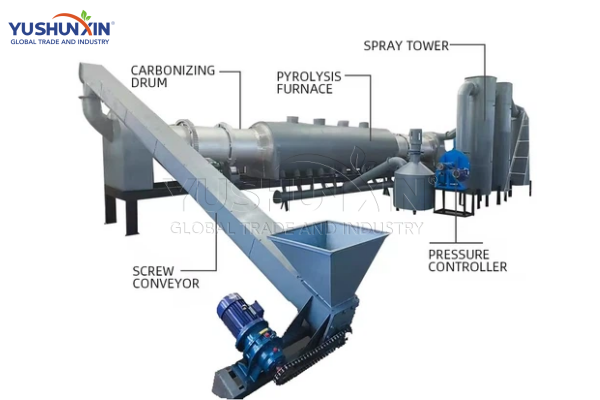
Traditional batch carbonization systems often require manual feeding, uneven heating, and higher labor costs. In contrast, continuous carbonization technology allows raw materials to be fed automatically while maintaining stable temperature and oxygen-controlled conditions.
This continuous process improves:
- Production efficiency
- Fuel utilization rate
- Product consistency
- Labor cost control
For start-up biochar projects targeting agricultural biochar, BBQ charcoal fines recycling, or biomass waste valorization, stable and scalable production is essential. A continuous system ensures that you can begin with moderate capacity and later expand without replacing the entire line.
Suitable Raw Materials for Biochar Production
A low-cost continuous carbonization machine is highly adaptable to various biomass feedstocks, including:
- Sawdust and wood chips
- Rice husk
- Coconut shell
- Corn cob
- Palm kernel shell
- Agricultural straw
The moisture content is typically recommended below 15% for optimal carbonization efficiency. The system converts biomass into high-carbon biochar under oxygen-limited conditions at temperatures between 400–700°C.
The result is a stable carbon product suitable for soil improvement, carbon credit projects, and further briquetting or granulation.
Key Advantages for Start-Up Projects
1. Lower Initial Investment
Compared with large industrial pyrolysis plants, a compact continuous carbonization unit requires less land area and lower infrastructure cost.
2. Energy-Saving Design
Modern systems recycle combustible gases generated during carbonization back into the furnace for self-heating. This significantly reduces external fuel consumption.
3. Easy Operation & Automation
Integrated control systems allow temperature monitoring and automatic feeding, reducing dependence on skilled labor.
4. Scalable Capacity Options
Start-ups can choose smaller capacities (300–500 kg/h) and upgrade later as market demand grows.
Market Opportunity and Long-Term Value
With growing interest in carbon removal initiatives such as those supported by organizations like International Biochar Initiative and carbon credit platforms aligned with the Paris Agreement, biochar production is increasingly linked to climate finance opportunities.
A low-cost continuous carbonization machine provides an entry point into this expanding market. It allows entrepreneurs to convert agricultural waste into value-added carbon products while contributing to environmental sustainability.
For start-up biochar projects, the right equipment is not just about production — it is about building a scalable, profitable, and climate-aligned business from day one. Visiting: https://www.char-molder.com/product/continuous-carbonization-furnace/
Leave a Reply